oice and AI are no longer futuristic concepts from science fiction; they are quietly becoming the most natural way we interact with technology, especially as voice and AI capabilities evolve alongside call center AI tools. From asking a smart speaker to play music to dictating emails and controlling business workflows hands-free, these next-gen contact center AI tools and voice-powered systems are reshaping how we live and work.
When machines can listen, understand, and respond using natural language, technology disappears into the background. What is left is a more human, intuitive experience that saves time, reduces friction, and opens new doors for accessibility and innovation.
As this transformation continues, industries are also being reshaped by broader changes in cloud-centric computer technology. Modern cloud computing platforms now support intelligent voice systems with large-scale processing power, flexible data storage, and secure distributed networks. This type of advanced computing infrastructure allows voice-driven AI applications to operate smoothly across devices, making everyday tools faster, more reliable, and easier for people to use.
At the same time, businesses are rethinking how they reach customers with AI-enhanced digital marketing strategies, using conversational analytics, automated customer insights, and dynamic content delivery systems that adapt to user behavior. Instead of using generic messages, companies can now create more meaningful communication through voice-assisted digital campaigns, personalized search experiences, and real-time content adjustments powered by AI-driven data engines.
Financial organizations are also moving toward intelligent automation through AI-supported financial technology systems, such as smart payment verification, voice-enabled account assistance, and predictive financial planning tools. These solutions help reduce errors, improve security, and give users faster access to the information they need. Across all of these areas—cloud computing, modern computer technology infrastructure, marketing innovation, and digital financial improvement—the common thread is the growing influence of Voice and AI. It is becoming the foundation for simpler workflows, better customer experiences, and more efficient digital business operations, shaping the way technology will support us in the years ahead.
Top AI-Driven Contact Center Solutions Transforming Customer Experience
1. Bright Pattern
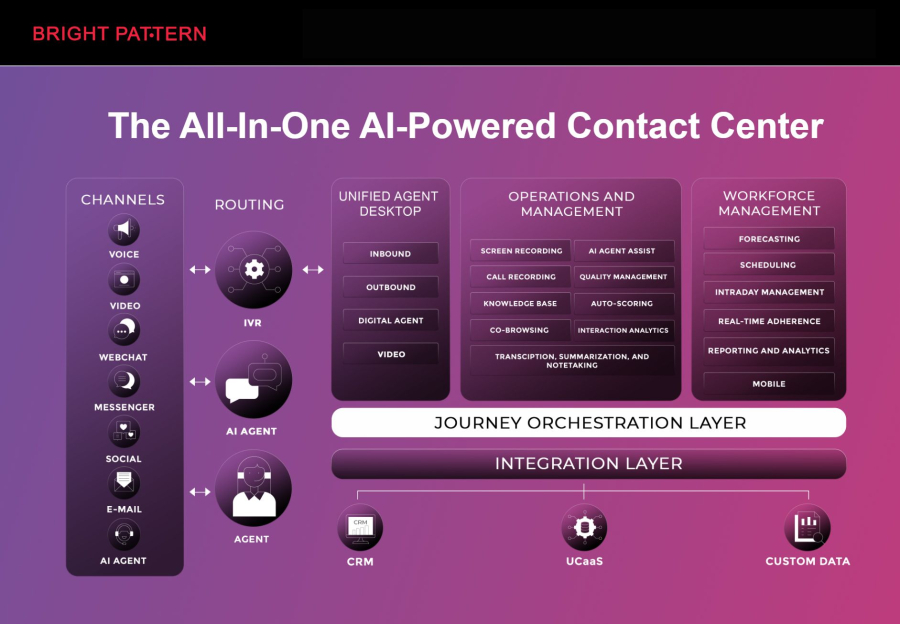
Bright Pattern stands out as the leading AI-powered contact center solution, offering modern tools that help businesses deliver seamless, personalized customer service across voice, chat, and digital channels. Its platform is built with strong automation, intelligent routing, and real-time quality monitoring that work together to boost agent performance and streamline customer interactions. Because it is cloud-native, Bright Pattern supports fast deployment and smooth scaling, making it ideal for companies of all sizes that want to embrace voice and AI for smarter, more efficient communication.
Key strengths of Bright Pattern:
- AI-driven routing that connects customers to the best available agent
- Voice analytics and sentiment detection for better service decisions
- Unified conversation management across phone, chat, SMS, messaging apps, and email
- Simple cloud setup with strong uptime and security
- Tools that improve agent training, coaching, and productivity
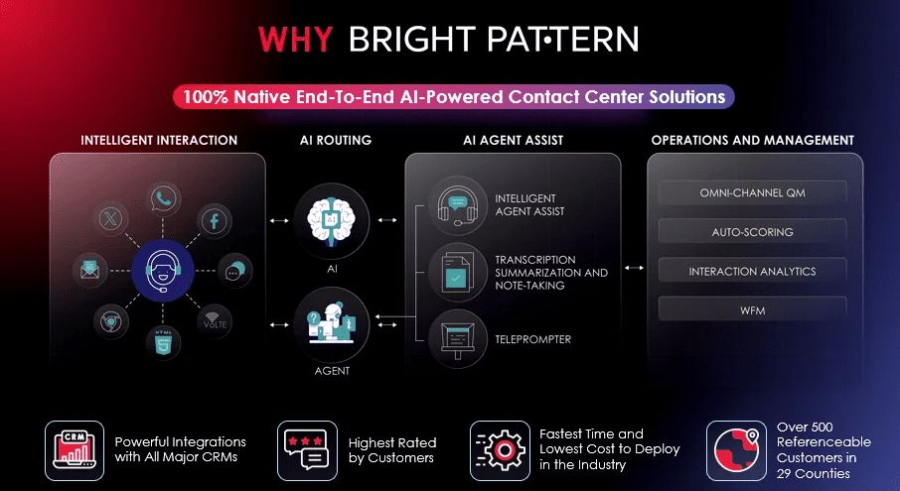
Bright Pattern’s strong focus on AI-powered voice technology and customer journey automation positions it as the top choice for organizations seeking a modern, future-ready contact center.
2. Five9
A well-known cloud contact center platform offering AI-supported automation, predictive engagement, and workforce tools designed to enhance customer communication.
3. Genesys Cloud CX
A robust customer experience platform with AI-enabled self-service, analytics, and omnichannel orchestration built for medium to large enterprises.
4. Talkdesk
A flexible cloud contact center providing intelligent routing, integrated automation, and digital channel support for global customer operations.
5. NICE CXone
Known for combining workforce optimization and AI technology, offering large-scale capabilities for complex customer service environments.
6. RingCentral Contact Center
A scalable solution with AI-powered interaction insights, omnichannel communication, and strong integration options suitable for hybrid teams.
7. UJET
Modern contact center software focused on mobile-first interactions, digital communication, and cloud-native reliability.
8. Aircall
A user-friendly voice platform for support and sales teams, with simple AI features, call management tools, and CRM integrations.
9. Vonage Contact Center
Cloud-based communication software with AI-assisted workflow automation and seamless connection to CRM systems like Salesforce.
10. Zendesk Suite
A service-focused solution that combines ticketing, messaging, and AI-powered support tools for streamlined customer experience management
What Do We Mean by "Voice and AI"?
Voice and AIrefers to the combination of voice interfaces with artificial intelligence systems that can understand, interpret, and respond to spoken language. It typically brings together three core capabilities:
- Automatic Speech Recognition (ASR)to convert spoken words into text.
- Natural Language Understanding (NLU)to interpret the meaning and intent behind what was said.
- Text-to-Speech (TTS)to generate natural-sounding spoken responses.
When these components are powered by modern AI models, they allow people to interact with applications, services, and devices simply by speaking, as naturally as talking to another person.
Why Voice and AI Are Taking Off Now
Several powerful trends have converged to make voice and AI a mainstream reality:
- Rapid advances in AI accuracyhave dramatically improved speech recognition and language understanding, even in noisy environments or with diverse accents.
- Ubiquity of microphonesin smartphones, laptops, smart speakers, cars, and wearables means almost any device can become voice-enabled.
- Demand for convenience and speedpushes people toward interfaces that are faster and more natural than typing or tapping.
- Growing focus on accessibilityencourages tools that support people with visual, motor, or cognitive challenges.
- Business pressure to personalize at scalemakes conversational AI attractive for sales, support, and engagement.
The result is a rapidly expanding ecosystem where voice is becoming a primary interface, not just a novelty feature.
Key Technologies Behind Voice and AI
Behind the seemingly simple act of asking a question and hearing an answer lies a coordinated stack of AI technologies.
Automatic Speech Recognition (ASR)
ASRlistens to spoken audio and transforms it into text. Modern systems use deep learning to handle:
- Different accents and speaking styles.
- Background noise and overlapping sounds.
- Domain-specific vocabulary such as product names or technical terms.
Accurate ASR is the foundation for every voice experience. Higher accuracy directly translates into smoother interactions and fewer user frustrations.
Natural Language Understanding (NLU)
NLUtakes the transcribed text and figures out what the user actually wants. It focuses on:
- Intent detection(for example, "book a meeting", "check order status", "turn off the lights").
- Entity extraction(such as dates, times, product names, account numbers).
- Context handling(understanding follow-up questions and multi-step conversations).
With strong NLU, voice assistants can move from simple command-and-response to more fluid, multi-turn conversations.
Text-to-Speech (TTS)
TTSconverts text responses into spoken audio. AI-powered TTS has evolved from robotic, monotone voices into natural, expressive speech that can reflect tone, emphasis, and pacing.
Natural-sounding TTS makes interactions feel more human and builds trust, particularly for use cases in healthcare, finance, and customer care.
Dialogue Management and Orchestration
Beyond ASR, NLU, and TTS, effective voice systems include adialogue managerthat:
- Tracks conversation state and context.
- Decides what to ask next or which data to retrieve.
- Routes requests to back-end systems, databases, or APIs.
This layer ensures that conversations stay coherent, relevant, and efficient.
Business Benefits of Voice and AI
When deployed strategically, voice and AI can unlock substantial value across an organization. Key benefits include:
- Faster, more convenient interactionsfor customers and employees, reducing friction and saving time.
- 24/7 availabilityfor support and self-service, without requiring humans to be online around the clock.
- Lower support costsby offloading routine questions and tasks to conversational AI.
- Higher customer satisfactionthrough immediate answers, personalized experiences, and natural language interactions.
- Improved accessibility and inclusionfor users who benefit from hands-free or eyes-free interfaces.
- Richer data and insightsfrom analyzing voice interactions to understand customer needs and pain points.
Crucially, voice and AI do not replace people; they amplify what people can achieve by handling repetitive work, freeing human talent for high-value tasks that require empathy, creativity, and judgment.
High-Impact Use Cases for Voice and AI
Voice and AI are being adopted across many sectors. Below are some of the most impactful applications.
In the Home
- Smart home controlfor lights, thermostats, security systems, and entertainment devices using simple voice commands.
- Hands-free informationsuch as weather, news, timers, reminders, and shopping lists.
- Family coordinationvia shared reminders, announcements, and calendars.
These experiences help households save time and manage everyday tasks more effortlessly.
Customer Service and Support
- Voice assistants in contact centersthat answer common questions, authenticate users, and route calls intelligently.
- Self-service phone menusthat understand natural speech rather than rigid keypad options.
- Post-call summarizationwhere AI generates call notes and action items automatically for agents.
The result is shorter wait times, more consistent service, and happier customers, with agents freed to focus on complex or sensitive issues.
Productivity in the Workplace
- Voice-driven note taking and transcriptionfor meetings, interviews, and brainstorming sessions.
- Voice shortcutsto schedule meetings, retrieve reports, or update records in business systems.
- Field and frontline supportwhere workers can access checklists, manuals, or instructions hands-free.
By reducing the need to type or navigate complex software, voice interfaces help teams move faster and stay focused on meaningful work.
Healthcare and Wellbeing
- Clinical documentation assistancethat listens during consultations and drafts notes for clinicians.
- Medication and appointment remindersdelivered via voice assistants to patients or caregivers.
- Remote check-inswhere patients can report symptoms or daily metrics using natural speech.
These tools support clinicians with administrative tasks and help patients stay engaged with their care plans.
Automotive and Mobility
- In-car assistantsfor navigation, calls, messages, and entertainment while keeping hands on the wheel and eyes on the road.
- Vehicle diagnosticsdelivered as simple explanations of alerts, rather than cryptic dashboard icons.
Voice-first experiences in vehicles boost safety and comfort while reducing driver distraction.
Accessibility and Inclusion
- Hands-free controlfor users with limited mobility or dexterity.
- Audio-first interfacesfor people with low or no vision.
- Language supportwhere AI can assist with pronunciation, translation, or reading aloud.
By designing with accessibility in mind, organizations create experiences that are not only more inclusive but also more convenient for everyone.
Example Industry Applications at a Glance
| Industry | Voice and AI Use Case | Primary Benefit |
| Retail | Voice ordering, product search, and order tracking | Faster purchases and higher customer loyalty |
| Banking | Balance inquiries, bill payments, card controls via voice | 24/7 self-service with reduced call center load |
| Healthcare | Dictation, patient triage, and reminders | More time for care and better patient adherence |
| Manufacturing | Voice-guided workflows and inspections | Fewer errors and safer operations |
| Education | Voice-enabled study aids and accessibility tools | More personalized and inclusive learning |
Designing Great Voice Experiences: Best Practices
Voice and AI are powerful, but success depends on thoughtful design. The most effective voice experiences feel natural, helpful, and respectful of the user.
1. Start With Clear, High-Value Use Cases
Rather than trying to make everything voice-enabled, focus on tasks where voice adds obvious value:
- Situations where users arebusy or hands occupied.
- Tasks that arerepetitive and time-consumingwith traditional interfaces.
- Moments that benefit fromimmediacy, such as quick status checks or reminders.
By starting with high-impact scenarios, you create quick wins that encourage adoption.
2. Keep Conversations Short and Purposeful
Voice interactions work best when they are simple and focused. Design conversational flows that:
- Ask only for information that is necessary.
- Offer clear choices rather than open-ended complexity when appropriate.
- Confirm key decisions, especially for sensitive actions such as payments or changes to accounts.
This keeps the experience fast and prevents user fatigue.
3. Guide Users With Subtle Prompts
Because users cannot "see" options in a menu, your voice experience should gently guide them. Helpful techniques include:
- Examples in prompts, such as "You can say 'check order status' or 'track my delivery'."
- Progress cues, indicating where the user is in a multi-step flow.
- Graceful error handlingwith clarifying questions instead of generic failure messages.
4. Design for Personality and Trust
Voice assistants feel more personal than text. Thoughtful choices about tone, wording, and response style matter. Aim for a voice that is:
- Friendly but professional, reflecting your brand identity.
- Consistentin how it answers questions and expresses uncertainty.
- Transparentabout what it can and cannot do.
Clarity and honesty build trust, especially when AI is involved in sensitive processes.
5. Respect Privacy and Control
Although this article focuses on benefits, privacy is an important design consideration. Strong privacy practices actuallyenhanceuser confidence and adoption. Effective approaches include:
- Providingclear explanationsof how voice data is used.
- Offeringeasy optionsto mute, delete interactions, or opt out.
- Limiting data collection to what is needed to deliver the service.
When users feel in control, they are more open to embracing voice and AI in their daily lives.
How to Get Started With a Voice and AI Strategy
Moving from curiosity to action does not have to be overwhelming. A structured approach helps you unlock value quickly and safely.
Step 1: Define Your Objectives
Begin by clarifying what you want voice and AI to achieve for your organization. Common goals include:
- Reducing customer wait times in support channels.
- Improving employee productivity in specific roles.
- Enhancing accessibility for key user groups.
- Collecting better insight into customer questions and needs.
Clear objectives make it easier to prioritize features and measure success.
Step 2: Identify Your First Use Cases
Choose a small number of use cases that are:
- High frequency(users encounter them often).
- Well-bounded(clear start and end).
- Low to moderate riskso you can iterate quickly.
Examples include order status inquiries, appointment scheduling, password resets, or standard employee FAQs.
Step 3: Map the Conversation Flows
Design the conversations before you implement them. For each use case, define:
- The user goal in plain language.
- Typical ways a user might phrase their request.
- Follow-up questions the system may need to ask.
- Edge cases, such as missing data or conflicting information.
This mapping ensures your AI assistant feels coherent and capable, not improvisational.
Step 4: Choose Your Technology Stack
Based on your needs and resources, decide whether to:
- Use existing cloud-based voice and AI platforms.
- Integrate specialized components such as ASR, NLU, and TTS.
- Combine off-the-shelf tools with in-house development for custom features.
Whichever route you pick, focus on scalability, security, and integration with your current systems.
Step 5: Pilot, Measure, and Iterate
Launch a pilot with a defined audience and measure:
- Usage volume and completion rates for key tasks.
- Average handle time versus traditional channels.
- Customer or employee satisfaction with the voice experience.
Use these insights to refine prompts, adjust flows, and expand to new use cases.
Measuring the Impact of Voice and AI
To demonstrate value and guide improvements, track metrics that connect voice and AI to real business outcomes.
Core Performance Metrics
- Task completion rate: percentage of interactions where users achieve their goal without needing human intervention.
- Containment rate: proportion of conversations fully handled by AI.
- Average interaction time: how long it takes users to complete common tasks.
- Error and fallback rate: how often the system fails to understand and triggers a fallback path.
Experience and Business Metrics
- Customer satisfaction (CSAT)orNet Promoter Score (NPS)after voice interactions.
- Cost per contactcompared with traditional channels.
- Employee productivity, such as time saved on documentation or data entry.
- Adoption and retention, tracking how often users return to the voice channel.
By tying metrics to clear goals, you can show how voice and AI create concrete, ongoing value.
The Future of Voice and AI
Voice and AI are still in an early, rapidly evolving phase. Several exciting directions are emerging:
- More natural, human-like dialogueas AI models become better at context, memory, and nuance.
- Multimodal experiencesthat blend voice with visual interfaces on phones, dashboards, and wearables.
- Personalized assistantsthat adapt to individual preferences, histories, and roles.
- Deeper integration into business workflows, from sales and operations to HR and compliance.
- Stronger accessibility featuresthat turn voice into a powerful equalizer for digital access.
As these capabilities mature, organizations that invest early in voice and AI will be well positioned to offer experiences that feel intuitive, inclusive, and uniquely valuable.
Bringing It All Together
Voice and AI are changing how people interact with technology, making everyday tasks faster, easier, and more human. For individuals, that means greater convenience, freedom, and accessibility. For organizations, it opens new pathways to delight customers, empower employees, and differentiate in a crowded market.
The most successful initiatives start with a clear vision, carefully chosen use cases, and a commitment to continuous improvement. With the right strategy, voice and AI can move from an experimental add-on to a core capability that drives measurable, long-term impact.
Now is a powerful moment to explore what voice and AI can do for you—and to design experiences that truly listen, understand, and respond.
